Sunday, October 30, 2011

Valencia, The Social Network


The Social Network follows the life of Mike Zuckerberg, the world’s youngest billionaire, as he creates (and is sewed over) one of the most important websites of our time: Facebook. I believe there is a political message behind this film; however I feel there is a more important message about how modern-day society is evolving.

The political message behind The Social Network is that privacy is a thing of the past. Things on the internet aren’t written in pencil, they’re written in ink. The only difference however is that with facebook, you choose which information you put out for the entire world to see. It’s strange to me that multitudes of people will complain about invasion of privacy, yet many of the same people will post the most intimate details of their lives on the internet for all to see.  

I think that social networking is both positive and detrimental to society. Facebook is like a gun, it’s a tool. However in the wrong hands that tool can seriously harm someone. Now I’m not saying facebook is the devil, I’m not gonna lie, it’s a pretty awesome tool to keep in touch with friends who are out of state or in different countries. There are some major problems with facebook and social networking in general.

First off, it is changing the way people interact with each other face-to-face and this is particularly evident in younger generations. In my opinion, kids are losing their guts (not literally of course). People start fights on the internet because they are too scared to actually confront a person and look them in the eye. Another problem is many people seem completely different in real life as compared to the internet. I think that a barrier is put up; a sort of virtual comfort zone that people can hide behind instead of dealing with things in real life. This leads to a lot of “fake” people. This is my main problem with social networking in general.

Another thing, I don’t think employers or schools should have access to your facebook page. I believe access to a criminal record is good and understandable, but not to facebook. I don’t believe one should be judged on their personal lives outside of work or school when being considered for employment or acceptance.  Many jobs and scholarships have been lost to pictures on facebook.

All in all, I believe facebook is a tool that can be used positively or negatively. It all depends on you. Just make sure you do some housekeeping on your photos every once in a while. It can avoid some rather unpleasant situations. I think it’s agreeable that some things just shouldn’t be shared.

Friday, October 21, 2011

Valencia, The West Wing


The image of the presidency that The West Wing creates is very idealistic. In West Wing, the president is represented as a kind, caring, compassionate, father figure. He is reasonable, fair, honest, and in control. He is even a God-fearing man, not to mention he has a great head of hair. All of these things are fine and dandy; I mean who wouldn’t want a president like him? He is by all means perfect for the job. Unfortunately, this image of the president is unrealistic.  

I believe the image that West Wing gives the president is unrealistic for a couple of reasons. First off, the president portrayed in West Wing is sincere and honest. When was the last time a president was honest during a campaign? How about while in office? I would say probably before the media became a huge part of campaigning. Politicians are known for their dishonesty and ulterior motives.

In West Wing the president seemed to actually stand up for what he believed in. What he believed in was also (surprisingly) not profit! Wow, what a guy. Back in real-life land, it is impossible to win the office without money or large corporate benefactors. With large sponsors come large responsibilities, or at least responsibilities to one’s sponsors. This renders many candidates vulnerable to becoming, basically, puppets for their benefactors.

I think my biggest problem with the image of the president is that he is portrayed as a real, genuine, honest, person. He doesn’t put up a façade or portray himself as something he is not. He doesn’t seem to have ulterior motives and appears to be genuinely interested in the welfare of the country and its people. He seems to be a man of his word who works for the common good. How many presidents truly fit this description?

Some of my favorite presidents include good ol’ Honest Abe, JFK, George Washington, FDR, and Teddy Roosevelt. Each president I listed worked for the common good and brought positive change. Abraham Lincoln freed the slaves, something that was very controversial at the time. He was then assassinated. JFK empowered the average American and even started withdrawing troops from Vietnam. He was then assassinated. Teddy Roosevelt was shot while giving his speech, yet he persevered. George Washington was a general in the American Revolution, literally fighting for what he believed in. These were all good men who stood up and stood out, and they had power. Nowadays, it is the good men who stand up and stand out who are punished. It seems that since the dawn of mass media, the presidency has declined into a contest of false images, empty words, and who has the bigger campaign sponsors. 


Friday, October 14, 2011

Valencia: Socialism

According to socialistagenda.info, socialism is defined as: “…a theoretical economic system that advocates the vesting of the ownership and control of the means of production and distribution in the community of stakeholder as a whole.” This is, for the most part, how I view socialism. Basically it means there are no “higher-ups” in control of everything. It means the person who makes the bread is just as important as management. The root of the word socialism is, of course, social; and this is where the power lies.

I have a very open mind when it comes to politics. I have studied various systems of government from monarchies to anarchy (which is the complete lack of government.) What is appealing about socialism is that it puts everyone in power; which, in its pure theoretical pure form, keeps greed in check. In theory, under a system of socialism, CEOs would not be able to make the billions they do today unless the workers had significantly higher salaries. I look at socialism rationally and for what it is. Socialism is an equal distribution of power, economically. I think of socialism as economic democracy.

What’s so bad about socialism then? It is arguable that socialism takes away motivation and incentives to work hard in order to gain power. A theoretical argument is “Why would I want to work hard to become a CEO when the pay isn’t all that much better?” This is a valid point. However, what I believe where the danger lies is in the misconception of socialism. This is the first image I found when I searched “socialism” 
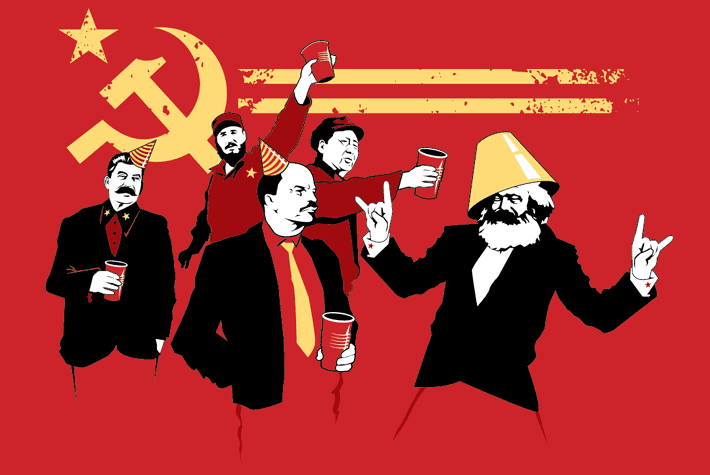
This is a blatant misinterpretation of socialism. The sickle and hammer is the symbol of communism. This would be like having a sign shaped like a hamburger that says “Hot dogs for sale” on it. This is the symbol for the socialist party in the US.
The problem is lots of people mistake socialism for communism, or fear socialism will inevitably lead to communism. According to Merriam-Webster socialism is defined as:

3. A stage of society in Marxist theory transitional between capitalism and communism and distinguished by unequal distribution of goods and pay according to work done.
  
Of course there's nobody who likes communism because they associate it with these guys.


Friday, October 7, 2011

Valencia: Capitalism

I believe an obviously slanted film does have the ability to change a person’s mind. Certainly a slanted film won’t change most people’s minds, however I believe slanted films are especially powerful to those who feel. When I say feel I mean people that make decisions based on emotion rather than mentally thinking about and analyzing the facts in order to form their own opinion.

One scene I think is emotionally effective is, well, actually all the scenes that involve tears. Pulling at the viewer’s heart strings is always a great way to form an opinion, that is, if the person operates emotionally. Now a scene I find effective without relying on emotion is the scene where the factory workers occupied the factory until they got their paychecks. I think this scene is effective because it is the classic “underdog versus the big guy/the man” scenario. The workers fought for what they believed in and for what they deserved until they got it. Who doesn’t love when the underdog wins?

One scene I found ineffective was the whole Obama scene. He makes Obama out to be, well basically, a savior. People are crying, everyone’s chanting, WOO change! Alright, oorah, I’m down to change things. I think this was all just too much though, especially considering our situation today. Don’t get me wrong, Barack’s alright. He definitely is a leap from our last president as far as our image goes. Still though, all that hope and change, my take on it is if you can’t notice it; you’re doing it wrong. What’s important is people want positive change though.

In short, I believe Capitalism: A Love Story is propaganda. According to dictionary.com propaganda is defined as” information, ideas, or rumors deliberately spread widely to help or harm a person, group, movement, institution, nation, etc.” This is my main complaint about this movie. It’s literally propaganda. I much prefer the Frontline type of documentary. It is well put together and most importantly lays out the facts for what they are. It is a documentary, not propaganda. I don’t think Michael Moore laid out the opposing argument in a proper manner because his film is about entertainment and propaganda. Capitalism’s purpose is to sway opinion while Frontline’s purpose is to present the viewer with the facts and allow the viewer to form their own opinions like big boys and girls. I’ve never liked being told how to feel about something, it’s very child-like. I’ve always preferred the facts; just the plain simple truths.

In conclusion, I believe Frontline is much more powerful as a documentary. Capitalism is much more effective as entertainment and propaganda. Each one serves its purpose well.
                                                              http://www.michaelhacker.at

Friday, September 30, 2011

Valencia Traffic


                                                                southparkstudios.com

(For soundtrack go to bottom)
What are drugs? In general, a drug is any substance that, when absorbed into one’s system, alters normal bodily function. Drugs have a broad spectrum, ranging anywhere from Tylenol to black tar heroin. This includes cannabis, psychedelics, methamphetamines, opiates, alcohol, and nicotine, among many other drugs. There are good drugs and bad drugs, but just because they are legal does not mean they are good for you. Drugs are bad mmkay, but a drug war is worse.

The term “drugs” is a way to broad term to be used, it lumps together completely different substances with completely different effects under one umbrella. What if someone were to set you up someone and all they would say is I want to set you up with a woman/man? Not very specific and there is an infinite range of possibilities. The same goes for drugs. A cannabis user is much different from a meth addict. An alcoholic is much different from a heroin junkie. The right (or wrong) drugs can destroy lives, homes, and people; but so can a drug war.

This war has been going on for decades and what has happened? Drugs have gotten cheaper and better in quality. Not a very big success if the opposite of your goal is accomplished. This war is by definition a failure and a waste of resources. I do not think we should abandon the war however. I am all for eliminating as much drug abuse as possible. I don’t believe we should be waging a war on supply though. There will always be supply as long as there is demand, making it illegal will increase demand, price, and now because it’s illegal more crime has been created.

We should legalize all drugs. I am not for solely decriminalization though. This simply means cops will turn a blind eye to drugs, which leaves the cartels intact and gives them much more power. I believe in legalization and regulation because it puts the cartels out of the drug business, which is their number one income. Historically prohibition raises violent crimes and demand. Legalization will not eliminate these problems, however it will reduce them drastically. There will always be drug users, abusers, and violent criminals, prohibition or not. So if you can’t fix the problem 100%, go for what will solve the problem the next best.  
There are many reasons to legalize. Our prisons are too crowded, too many people are dying because they are afraid of seeking help, and drugs are too easy to get. There are no “heroin anonymous” groups. Even in Traffic, a person is overdosing and the only logical thing his friends can think to do is to dump him in front of a hospital. One of the characters also said that he does drugs because they are cheaper and easier to get than alcohol. Legalization and regulation could change this. Drugs could get out of the hands of kids.

Therefore I believe in legalization and RESPONSIBLE use. A smart person won’t do heroin in the first place. Legalize and don’t be an idiot.


Friday, September 23, 2011

Valencia: American History X


American History X, starring Edward Norton, is a controversial film that delves into the lives of a family that is affected by neo-Nazism. Derek Vinyard, the oldest son, is a fierce neo Nazi who is well respected by the local skinhead gangs. One night a few black guys attempt to steal Derek’s truck. The truck is special to Derek because it was given to him by his father who was killed by a drug dealer while putting out a fire. Derek kills two of the black men, one of which he curb stomped (and who could forget that scene?) He is then arrested sent to prison for manslaughter. While in prison Derek undergoes a transformation and sheds his Nazi ways, while his younger brother Danny only gets deeper into the Nazi lifestyle and following Derek’s footsteps. Once Derek gets out he is dedicated to keep Danny from going down the same path he did.

Many people believe the film has an anti-racist message. Others, however, argue the exact opposite and say the film harbors pro-racist messages. Obviously this film can be interpreted many different ways. I believe this film’s message is anti-racist, however it does have racist messages in the dialogue. I do not believe that the film is pro-racism though. I believe in order to show the negative effects of racism it is necessary to actually show the argument of the other side. I don’t think the film would be as effective if the film simply said “Racism is bad mmkay” and doesn’t show the other viewpoint for what it is. It is necessary for the characters to be realistic. It’s easy to hate Seth the fat Nazi in his van, but how about Derek? He is intelligent, smart, and fit, but he’s a Nazi. He is important because he brings up the same arguments a real racist would bring up, yet at the end of it he sees that what he has done has not made anyone’s life better. In prison he is also gets a taste of his own medicine. He experiences what he was treating blacks like, which prompts him to change his ways.

Another argument for the film being pro-racist is that the characters are all extreme cases. The viewer might say, “Well I’m not a Nazi, so I must not be racist.” The film has two important characters who are not extreme cases; for example, Derek’s father. He is a normal US citizen. He has a job, a house, and a family. He is still racially prejudiced though. “What about the blacks? They’re all shown as if they were animals.” This isn’t true, look at Sweeney. A highly intelligent, well spoken, strong, respected black man with 2 PhD’s. Dr. Sweeney and Mr. Vinyard are both realistic characters.

In conclusion I believe this film has an anti-racist message but presents both arguments realistically. I believe that thinking this film is pro-racism is like thinking firemen are violent for using axes to break through doors.